



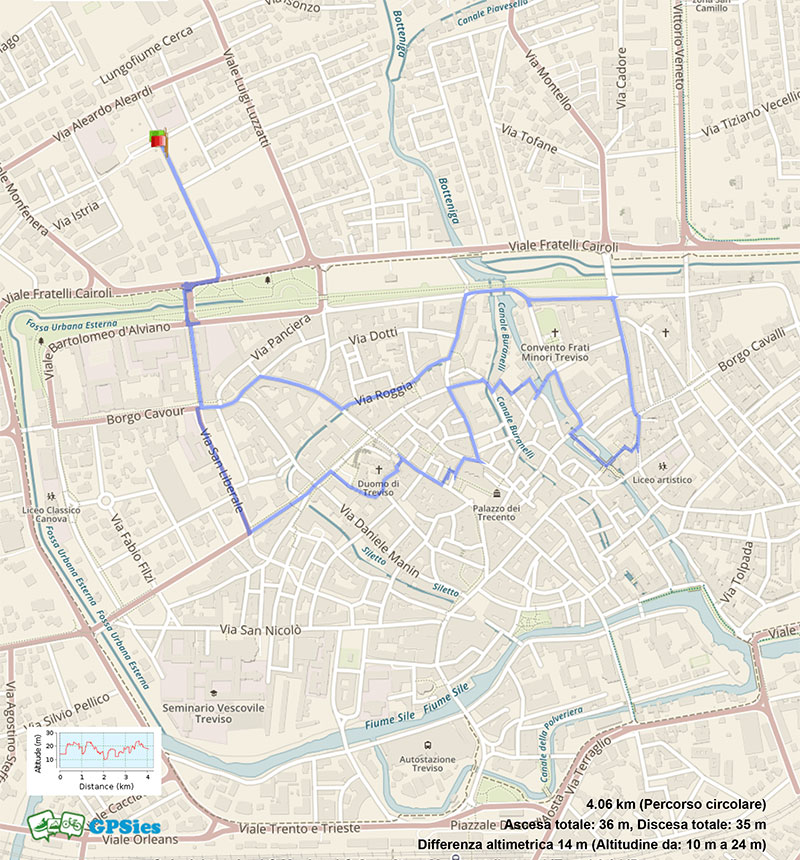
- Distance and Time required: 4 Km | 1.5 h
- Elevation gain: 26mt
- Starting Point: Parking in Via Lancieri di Novara a Treviso
- Short description: The Botteniga river enters Treviso, and its waters split into three canals that eventually flow into the Sile river. Let’s go and discover them, passing through some of the most characteristic corners of the city, such as the Cathedral, Piazza dei Signori, and the 'Fontana delle Tette' (Fountain of the Breasts)
- Stroller/Wheelchair accessible: Yes
The Walk
A walk like this just had to start near Treviso’s municipal aqueduct, with its building beautifully frescoed with sea-themed designs—if you look closely, you can even spot Poseidon, the Greek god of the sea.
We’ll walk towards the center and, once we reach the "PUT" (Viale Fratelli Cairoli), we’ll turn right and cross the street near Porta Caccianiga, which will be our gateway into the city heart. To our left, you'll see the public gardens of Treviso with the monument dedicated to the "Alpino" soldier in the storm.
Let’s step inside the city walls and keep going straight, first along Via Caccianiga and then, past the Borgo Cavour district, onto Via San Liberale until we reach Via Battisti. We’ll turn left and, just before reaching the Cathedral (Duomo), we’ll duck into the portico tucked between the Bishop’s residence and the Edizioni Paoline bookshop.
 The Acqueduct
 Mosaic
 Just a few steps more and we arrive at what was likely an early Christian baptistery, featuring a mosaic floor (covered during winter) with allegorical figures like dolphins, vine branches, and birds.
We continue our walk and, after a left-hand curve, instead of following Via Canoniche, we turn left into a tiny alleyway tucked behind the Cathedral; it offers a truly charming corner that we had never noticed before.
As we come to the end of the alley, we emerge near the Calmaggiore, Treviso’s main street that once linked spiritual power (the Cathedral) with worldly power (Piazza dei Signori). We head right, but before reaching the main square, we turn left into the "Galleria della Strada Romana" (look for the "Calmaggiore 10" sign at the entrance). A quick look at the shop windows and a few more steps, and then we turn right to meet the famous "Fontana delle Tette" (Fountain of the Breasts).
 Behind the Duomo
 Fontana delle Tette
 We move forward and find ourselves in Piazza San Vito, with the Nuovo Palazzo Littorio in the background; I personally consider its facade one of the most beautiful in the "capital" of the Marca Trevigiana.
The heat is starting to kick in a bit, but luckily the many porticoes allow us to walk in the shade. We continue along Via Municipio for about a hundred meters, then turn right into Via Sugana, following it to the end. Here, we find ourselves at one of the most photographed spots in Treviso: the Buranelli Canal. As the old photos remind us, this was once the place where washerwomen came to do their laundry.
 The Buranelli Canal
 The Cagnan Canal
We follow the signs for Palazzo Rinaldi, with its square surrounded by the buildings once owned by this noble family. We cross the square diagonally (to the left) and spot a turning waterwheel nestled among the greenery. We continue through the portico of the Odeon Restaurant, weaving between the tables, and find ourselves on Ponte San Francesco, the oldest stone bridge in the city. From here, we can get a better look at the waterwheel; the water flowing beneath our feet is the Cagnan Canal.
We head towards the Church of San Francesco and, once past the bridge, turn right into Via San Parisio and then further along into Via Pescheria. From here, we step directly into the Pescheria, right among the fish stalls. The "Pescheria" is a small artificial island built on the Cagnan Canal during the Austrian era specifically to relocate the city's fish market here.
 Pescheria
 Via Sant'Agostino
We pass through the fish market and take the alley on the left, where we stop for a drink at the fountain, before reaching Via Sant'Agostino. From there, we stroll under the "porteghi" (porticoes) to the left, first along Via Sant'Agostino and then Via Manzoni; we can already smell the delicious scents wafting from the kitchens—roast pork sandwiches, toasts, and various "cicchetti".
Reaching the end of the "porteghi," we turn left into Via Burchiellati until we reach Ponte de Pria, which offers a beautiful view over the city. This is where the Botteniga river enters the city and splits into the three canals: Cagnan, Buranelli, and the Roggia... the one still missing from our list.
 Ponte de Pria
 The Roggia Canal
We cross the bridge and turn left into Via Filippini. Just past Piazza Trentin, we take Via Roggia on the right, and here we are, facing the last and smallest canal: the Roggia. We continue straight along this street, then into Via Canova, passing by Casa da Noal until we reach Borgo Cavour. From here, we take Via Caccianiga and follow our initial path in reverse back to the parking lot.
Photo Gallery
Traditional Taste in Treviso

Vecia Hostaria dai Naneti
Cold cuts, cheese and typical venetian cicchetti
near Piazza dei Signori (at the right side of Benetton Store
Tel. 340 378 3158


Track Gps
What to see
Calmaggiore is the main street of Treviso’s historic center, a charming walk under elegant porticoes that connects the Cathedral to Piazza dei Signori. It’s the heart of city life, where history meets cozy shops and cafes, perfect for a relaxed stroll with the family.
The Early Christian Mosaic is a hidden gem located next to the Cathedral. This ancient floor, dating back to the 4th century, features beautiful decorations of dolphins and birds, offering a small but fascinating glimpse into Treviso's oldest history.
Fontana delle Tette (Fountain of the Breasts) depicts a curvaceous woman. During the Republic of Venice, to mark special celebrations, white and red wine used to pour from her breasts.
Cà da Noal is a medieval palace featuring an elegant Istrian stone doorway and a partially frescoed facade.
Traditional Taste in Treviso
Vecia Hostaria dai Naneti
Cold cuts, cheese and typical venetian cicchetti
near Piazza dei Signori (at the right side of Benetton Store
Tel. 340 378 3158
Refreshment Points
Fountains near the Duomo, the Pescheria and Via Sant'Agostino
Vecia Hostaria dai Naneti in Vicolo Broli 2 a Treviso - Tel. 340 378 3158
Curiosities
The division of the Botteniga’s waters into canals is part of a complex system of defensive hydraulic works designed by Fra Giocondo to protect the city during the Renaissance.